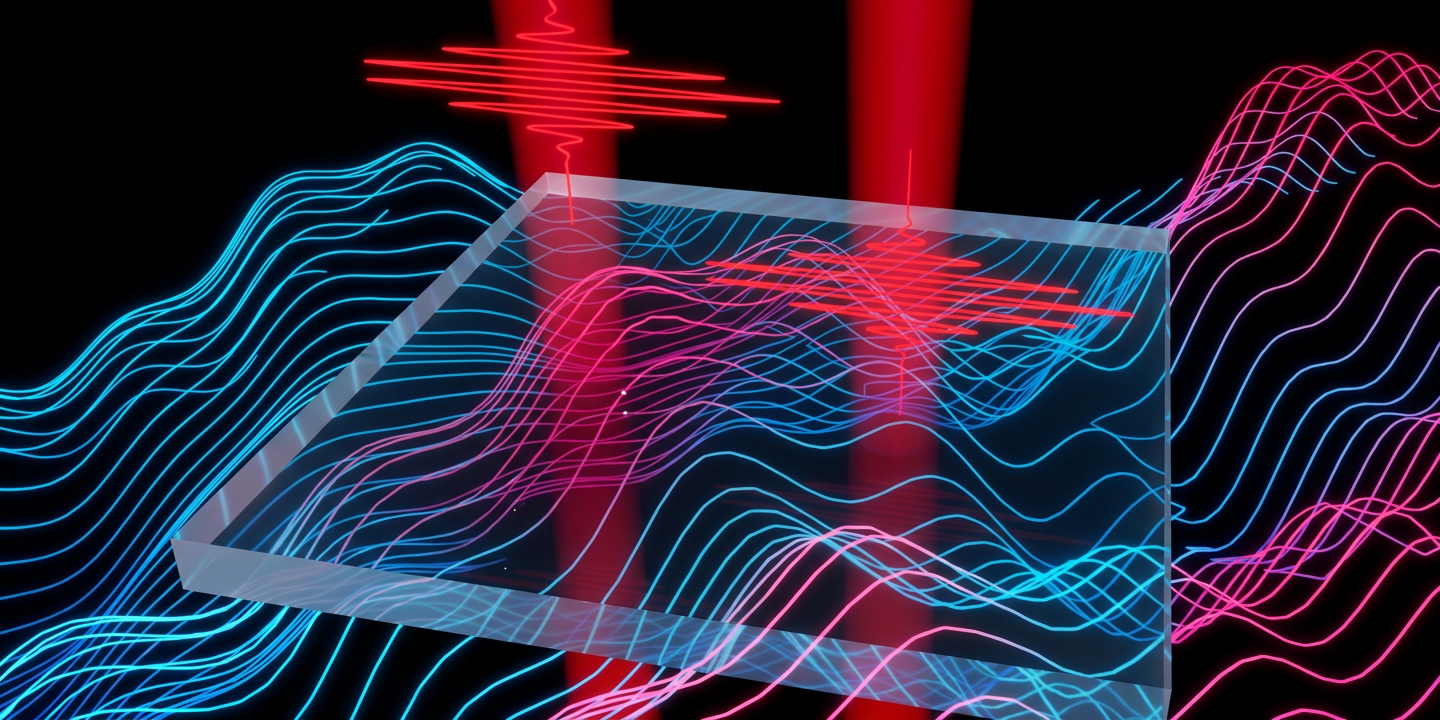
Most of us grow up thinking of “empty space” as… well, nothing. A quiet backdrop where planets move, light travels, and physics happens. But modern physics tells a far stranger story: even the emptiest regions of the universe are alive with activity. Welcome to the world of the quantum vacuum—where “nothing” turns out to be something extraordinarily rich.
The restless nature of nothing
In everyday life, a vacuum means removing air from a container. In physics, though, a true vacuum means removing everything—no particles, no radiation, nothing at all. Classical intuition says such a space should be perfectly still.
Quantum theory disagrees.
According to the principles underlying Quantum Field Theory, every type of particle—electrons, photons, quarks—is associated with a field that fills all of space. Even when there are no particles present, these fields don’t switch off. They continue to fluctuate due to the uncertainty built into quantum mechanics.
The result? Space itself is never truly empty. It’s more like a simmering ocean, constantly rippling with tiny, fleeting disturbances.
Virtual particles: appearing out of nowhere
One of the most fascinating consequences of this restless vacuum is the idea of virtual particles. These are short-lived excitations of quantum fields that briefly pop into existence and then vanish again.
This behavior is tied to the Heisenberg Uncertainty Principle, which allows energy to fluctuate for very short times. In simple terms, the universe can “borrow” a bit of energy—as long as it gives it back quickly.
Although virtual particles can’t be directly observed like ordinary particles, their effects are measurable. They subtly influence how forces behave and how particles interact.
The Casimir effect: pushing with nothing
Here’s where things get experimentally real.
If you place two extremely close, uncharged metal plates in a vacuum, they will actually attract each other—even though no classical force seems to be acting between them. This phenomenon is called the Casimir Effect.
Why does it happen?
The presence of the plates restricts how quantum fluctuations can occur between them, compared to outside. This creates a tiny imbalance in pressure from the vacuum fluctuations, effectively pushing the plates together.
In other words, “nothing” can exert a force.
From lab experiments to black holes
The quantum vacuum isn’t just a curiosity in tabletop experiments—it plays a role in some of the most extreme environments in the universe.
Near black holes, for instance, quantum fluctuations can lead to particle creation. This is the basis of Hawking Radiation, proposed by Stephen Hawking. In this process, black holes aren’t completely black—they slowly emit radiation and can eventually evaporate over enormous timescales.
What’s remarkable is that this effect arises from the same underlying idea: the vacuum isn’t empty, and under the right conditions, its fluctuations can become real, observable particles.
The vacuum and the fate of the universe
On the largest scales, the quantum vacuum might even shape the evolution of the cosmos.
Observations show that the universe’s expansion is accelerating, a discovery tied to the Dark Energy. One leading explanation is that empty space itself has an intrinsic energy—often called vacuum energy—that drives this acceleration.
Here’s the twist: theoretical predictions of vacuum energy from quantum physics are vastly larger than what we observe. This mismatch—sometimes called the “vacuum catastrophe”—is one of the biggest unsolved problems in physics.
Rethinking “nothing”
So the next time you think about empty space, it’s worth pausing.
What seems like nothing is actually a dynamic, fluctuating entity:
- It produces measurable forces
- It influences fundamental interactions
- It may even determine the ultimate fate of the universe
In modern physics, “nothing” is anything but simple.
And perhaps that’s the most intriguing idea of all: the deeper we look into the universe, the less empty it becomes.
 Musings Of A Physicist
Leave a comment